How to Mix Essential Oils: A Complete Guide to Safe Blending
Anyone who has ever sniffed a bottle of peppermint oil and wondered whether it can go straight on their skin already knows the first rule of blending: essential oils are concentrated, and concentration needs a carrier. The health publisher Healthline puts the practical ceiling for most recipes at 5% essential oil (Healthline (health publisher)), and you’ll learn the dilution math, the 20/30/50 note-balancing shortcut, and the combinations that are actually pleasant to wear.
Typical dilution for adults: 2–3% (12–18 drops per ounce of carrier oil) · Common blend rule: 20/30/50 (top/middle/base notes) · Maximum essential oils per blend: 3–5 oils recommended
Quick snapshot
- Some undiluted essential oils can be poisonous (Kaiser Permanente (integrated health system)).
- Dilution before skin contact is the non-negotiable first step (International Center for Essential Oil Education (ICEA)).
- Long-term effects of frequent inhalation are less documented than topical safety (Tisserand Institute (safety research)).
- The “right” dilution is personal: age, skin sensitivity, and the specific oil all move the number (AromaWeb (aromatherapy reference)).
- Citrus-forward blends fade fastest; woody base notes hold the scent longest (NAHA (aromatherapy association)).
- Start at 2% for healthy adults and 1% for children or elderly users (AromaWeb (aromatherapy reference)).
- After a patch test, keep notes on the blend and adjust only one oil at a time (International Center for Essential Oil Education (ICEA)).
Nine numbers that anchor almost every safe blend, one pattern: the lower the percentage, the wider the margin for error.
| Use case | Dilution / amount | Reference |
|---|---|---|
| Most oil-based blends | 1%–5% | NAHA (aromatherapy association) |
| Adult starting point | 2% | AromaWeb (aromatherapy reference) |
| 1% dilution | ≈6 drops per ounce carrier oil | Healthline (health publisher) |
| 2% dilution | ≈12 drops per ounce carrier oil | AromaWeb (aromatherapy reference) |
| 4% dilution | 24–30 drops per ounce carrier oil | International Center for Essential Oil Education (ICEA) |
| Pregnancy | 2% or lower | International Center for Essential Oil Education (ICEA) |
| Children or health-compromised adults | 1% or lower | International Center for Essential Oil Education (ICEA) |
| Infants and young children | 0.5%–2.5% depending on condition | NAHA (aromatherapy association) |
| Some oils and absolutes | dermal maximum of 1.5% or less | Tisserand Institute (safety research) |
The implication: if a recipe cannot be translated into a percentage, it is not a formula — it is a guess.
What Is the Best Way to Mix Essential Oils?
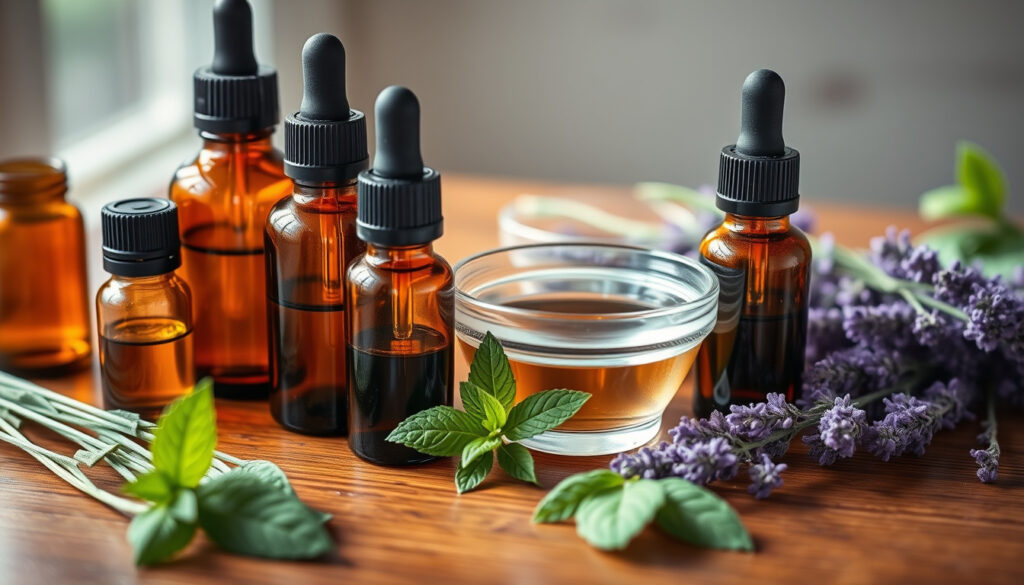
The best method is the one that keeps the math visible. That means working with a measured carrier oil, a dropper, and a labeled bottle — not pouring directly from the essential-oil bottle into your palm.
Step-by-Step Mixing Process
- Choose a carrier oil. Kaiser Permanente’s simple version of this rule: add the essential oil to a lotion, butter, or shampoo before it touches skin (Kaiser Permanente (integrated health system)).
- Measure the carrier into a dark glass bottle. A 1-ounce bottle makes dilution math straightforward.
- Add essential oil drops slowly, counting each one. Work with the safety range from the key table above.
- Cap, swirl, and label. Write the date, the oils, and the percentage on the bottle so you can recreate or adjust it.
- Patch test before full use. Apply a small amount to the inner arm and wait 24 hours.
Choosing the Right Carrier Oil
- Lotions, unscented butters, and shampoos are practical carriers that are already part of many skin-care routines.
- Liquid carrier oils like jojoba, sweet almond, or fractionated coconut are easy to measure in a 1-ounce bottle.
- Thicker balms and butters work for spot applications, but stir very thoroughly so the essential oil does not sit in one pocket.
Tools You Need
- Dark glass bottles (1-ounce bottles are easiest for drop math)
- Glass droppers or pipettes
- Measuring spoons or a small scale for carrier oil
- Labels and a marker
The pattern: every safety rule in blending comes back to one variable — concentration. If you control the percentage, you can fix almost everything else.
What Is the 20/30/50 Rule for Essential Oils?
Fragrance blending borrows a trick from perfumery: split the blend into top, middle, and base notes. The 20/30/50 rule is the simplest version of that idea, and it works as a structure rather than a chemistry law.
Understanding Top, Middle, and Base Notes
- Top notes (20%): the first impression — bright, quick, volatile scents like citrus and light herbs.
- Middle notes (30%): the heart of the blend — lavender, geranium, or chamomile-style scents that bridge top and base.
- Base notes (50%): the foundation and natural fixative — wood, resin, and earth notes like sandalwood or patchouli that linger longest.
How to Apply the Rule to Create Balanced Blends
The 20/30/50 rule fixes the main beginner mistake: too much top note means a blend that smells loud for twenty minutes and disappears. Give the base note the biggest share, and the blend still has a presence after an hour.
To use it, total your drops and assign 20% to top, 30% to middle, and 50% to base. For a 10-drop blend that’s 2-3-5; for a 20-drop blend it’s 4-6-10. The ratio stays the same even when the bottle size changes.
Examples of Note Classifications
- Top: lemon, bergamot, sweet orange
- Middle: lavender, geranium, chamomile
- Base: sandalwood, patchouli, cedarwood
The catch: 20/30/50 is about how a blend smells, not how strong it is. A “balanced” blend that ignores dilution is still a safety problem.
What Is the Proper Dilution of Essential Oils?
Dilution is the part of blending where safety and scent overlap. The health publisher Healthline puts the general ceiling for most recipes at 5% essential oil (Healthline (health publisher)). That is the guardrail; inside it, dilution depends on the person and the oil.
Dilution Percentages for Different Uses
1%: ≈6 drops per oz · 2%: ≈12 drops per oz · 4%: 24–30 drops per oz
One pattern runs through every set of numbers: percentages matter more than parts. The Tisserand Institute warns that a “1 part essential oil to 4 parts carrier” ratio creates a 25% solution — far too concentrated for almost any safe use (Tisserand Institute (safety research)).
Converting Drops to Milliliters
1 fl oz ≈ 30 ml · Standard dropper: roughly 20 drops per ml · Recipe math: keep drop-per-ounce consistent
Most formulas are written in drops per ounce because droppers are the tool most people have. If your bottle is metric, scale by volume: a 30 ml bottle uses the same drops as a 1-ounce bottle, and a 15 ml bottle uses half.
Safe Dilution for Children and Sensitive Skin
- National Association for Holistic Aromatherapy (NAHA) puts infants, toddlers, and young children at 0.5%–2.5% depending on the condition.
- Children or health-compromised adults should stay at 1% or lower, as shown in the key table above.
- When in doubt, halve the percentage for any user with sensitive skin or a history of reactions.
What this means: the “proper” dilution isn’t one number. It’s the lowest percentage that still does the job for your skin, age, and oil.
What Are the Best Essential Oil Combinations to Mix?
The best combination is the one that fits the moment — and stays inside the dilution limits. These pairings are popular starting points, not prescriptions, so keep your total concentration in the 1%–2% range unless the oil’s safety profile allows more.
Relaxation Blends
- Lavender + sweet orange — soft floral and gentle citrus, good for an evening diffuser or a 1% massage blend.
- Lavender + peppermint — a classic combo for tension headaches, but keep peppermint low because it is strong.
- Lavender + cedarwood or sandalwood — deeper base-note support for wind-down blends.
Energy Boost Blends
- Peppermint + lemon — sharp, clean, and energizing.
- Eucalyptus + rosemary — an herbaceous upper lift.
- Grapefruit + ginger — bright citrus with a warm spice edge.
Respiratory Support Blends
- Lemon + eucalyptus — a clean, fresh-scent pairing.
- Eucalyptus + peppermint — a breath-opening duo; dilute both carefully.
- Tea tree + lavender — a popular skin-care pairing, not a stronger blend just because both are “natural”.
These pairings work because they respect the same start-low-and-observe approach found in our evidence-based guides: How to Reduce Anxiety Naturally: 10 Evidence-Based Techniques and How to Reduce Inflammation Naturally: 7 Steps Backed by Science.
The trade-off: a six-oil blend smells interesting, but every extra oil is another variable. Three oils give you enough complexity to learn the trade without losing the ability to pinpoint what caused a reaction.
What Essential Oils Cannot Be Mixed?
There are very few absolute “never mix this with that” bans in aromatherapy. The real warning is about concentration, not color or brand.
Incompatible Chemical Families
- Menthol-heavy oils: peppermint and eucalyptus in the same bottle can feel cooling, but stacking high doses of both on skin is asking for irritation. Keep each one’s percentage low.
- High-limonene citrus oils: citrus-after-citrus blends raise the total amount of a sensitizing compound in one bottle. The general ceiling above is a maximum, not a goal.
- Spicy oils: cinnamon and clove are the classic irritants. Treat them as accent drops, not base notes.
Avoiding Phototoxic Oils
Citrus oils are the usual suspects for UV-related skin reactions. If you apply a blend with bergamot, lime, or other citrus oils to exposed skin, keep the concentration low and avoid sunbathing right after — the safety margin shrinks once UV enters the picture.
Oils That Cause Skin Irritation When Combined
- doTERRA’s safety guide suggests stronger oils can be diluted at 1 drop essential oil to 10 drops carrier oil (doTERRA (essential oil company)). That is a narrow ratio, not a free pass to double up on irritants.
- If you’re layering two strong oils, count the total drops, not each oil separately.
The pattern: the oils that “cannot be mixed” are usually the oils that can only be used at very low doses. Remove the dose problem and most mixing questions solve themselves.
What’s Clear and What’s Not
Confirmed facts
- You must dilute essential oils before putting them on skin.
- Most blend formulas stay below 5%.
- Lower percentages are the main safety lever.
What’s unclear
- Long-term outcomes from frequent inhalation remain less documented than topical safety.
- The “best” or “nicest” scent is subjective and tied to personal body chemistry.
- Whether a 10-year-old bottle is still good depends on storage, bottle opening frequency, and oil chemistry — there is no single expiration date.
The implication: the safety guidance is consistent on dilution; the flavor of “what works best” is personal.
What the Safety Voices Say
“A dilution should be understood as a percentage, not as a loose parts-based ratio. A ‘1 part essential oil to 4 parts carrier’ ratio is 25% oil — much too concentrated for almost any safe use.”
“Some undiluted essential oils can be poisonous.”
These voices reinforce that the percentage matters more than any rule of thumb—dilution is non-negotiable.
Summary
For the home blender, the difference between a calming ritual and a painful rash is rarely the essential oil itself — it’s the percentage. Keep healthy-adult blends comfortably inside the safety ranges above, drop to the lower end for children and sensitive skin, and measure every drop before you pour. A 2% blend fits most adults, a 1% blend fits most first-tests, and the 20/30/50 rule keeps the scent balanced. For anyone learning to blend, the choice is clear: measure every drop and label every bottle, or keep your routine to single oils until the math feels automatic.
scienceinsights.org, doterra.com, doterra.com, youngliving.com
Frequently asked questions
What holds essential oil smell longest?
In a blend, base notes are the fixatives. Woody and resinous oils like sandalwood, cedarwood, and patchouli linger longest, while citrus top notes fade first, which is why the 20/30/50 rule gives base notes the largest share.
What’s the nicest smelling essential oil?
There is no objective winner. Lavender and sweet orange are common favorites for relaxation, while sandalwood is prized for its warm, long-lasting base note. The best test is your own nose — smell two oils on a strip before blending.
Can I use 10 year old essential oils?
It depends on the oil and how it was stored. Woody oils typically last longer than citrus oils, and oxidation changes both smell and skin tolerance. If the scent is off, the texture has changed, or a patch test reacts, don’t use it.
What is the king of all essential oils?
Sandalwood is often given that nickname in aromatherapy circles because of its fixative quality and long-lasting scent. No official body assigns the title, so treat it as a compliment to sandalwood rather than a ranking.
What essential oil makes your house smell amazing?
Lemon and eucalyptus is a popular fresh-scent combo; lavender and sweet orange reads warmer and calmer. In a diffuser, keep oils away from skin and follow the diffuser’s water-to-oil instructions.
Who should avoid frankincense oil?
Anyone with sensitive skin should treat frankincense as a low-dose oil, since some oils have dermal maximums as low as 1.5% or less. Pregnant women should follow a 2% or lower dilution unless their clinician advises otherwise.
What is the most sought after essential oil?
Rose and sandalwood are traditionally the most prized, and they carry premium prices. Demand shifts with trends, though, so “most sought after” is a moving target.
More related posts
 When Does Stranger Things 5 Come Out? Release Schedule
 A Bronx Tale Cast: Where Are They Now in 2025
 Busiest Airport in the World 2024: ATL, DXB, and Top 10 Rankings
 Treadmill for Sale Ireland – Best Home Treadmills 2025
 EU 38 in UK Size: Shoes & Clothes Conversion Charts
 Weather in Cork Tomorrow: Dry, Sunny, No Storm Benjamin
 Cold and Flu Tablets: Best Ireland Picks Compared
 Major Internet Outage Today Ireland: Live Updates & Status Check