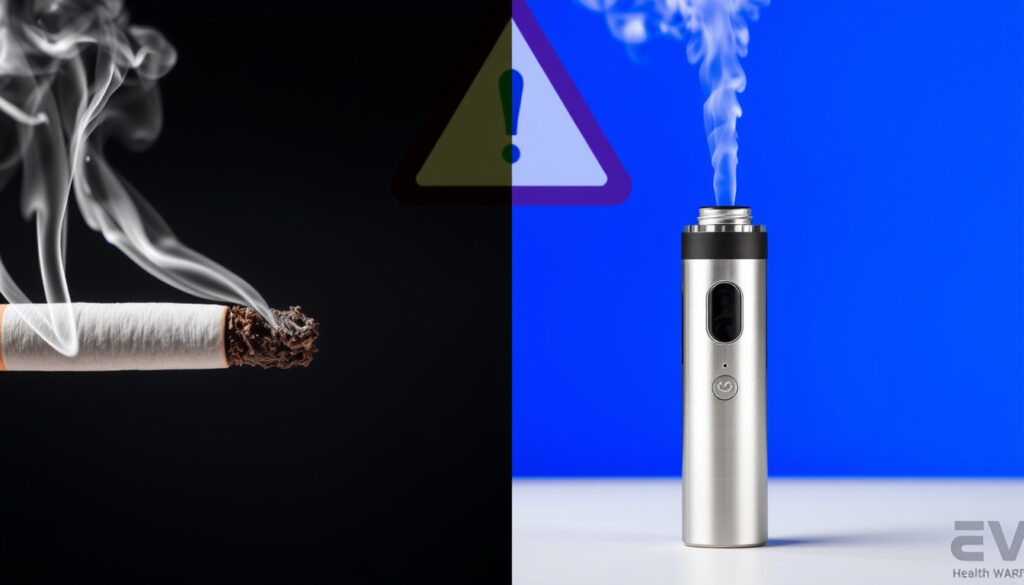
Is Vaping Better Than Smoking? Health Risks & Facts Comparison
If you’ve ever held a cigarette and a vape, the choice might seem obvious: vaping is safer. The truth is more layered — public health bodies agree it exposes you to fewer toxins but doesn’t make it harmless.
E-cigarette users exposed to fewer toxins than smokers: NHS ·
Vaping still linked to lung and heart function changes: CDC ·
Smoking causes 7 million deaths yearly worldwide: WHO ·
E-cigarettes contain no tobacco or most toxic chemicals: Cancer Research UK
Quick snapshot
- Vaping exposes users to fewer toxins and at lower levels than smoking (NHS) (WHO)
- Smoking causes 7 million deaths annually (WHO)
- E-cigarettes don’t contain cancer-causing tobacco (Cancer Research UK)
- Long-term health effects of vaping beyond 10 years
- Exact puff-to-cigarette equivalence across devices
- Whether vaping helps all smokers quit or encourages dual use
- The extent to which vaping contributes to cardiovascular disease over time
- In 2014, most smokers in England thought e-cigarettes less harmful than smoking (JAMA Network Open)
- By 2023, 57% believed they were equally or more harmful (JAMA Network Open)
- Over 30 countries have banned e-cigarettes
- UK experts continue to recommend vaping for smoking cessation while monitoring long-term effects
- Goal remains complete nicotine cessation
Here are key data points comparing smoking and vaping.
| Metric | Value |
|---|---|
| Number of toxins in cigarette smoke | 7,000+ |
| Carcinogens in cigarette smoke | 70 |
| Vaping toxin reduction estimate | 95% less harmful than smoking (Public Health England) |
| Smoking-related deaths annually | 7 million (WHO) |
| E-cigarette ban countries | Over 30 countries |
| E-cigarette aerosol contains fewer harmful chemicals | Yes — but not risk-free (CDC) |
Is it better for you to vape or smoke?
Key differences in toxins
Cigarette smoke contains more than 7,000 chemicals, at least 70 of which are known carcinogens (Cancer Research UK). E-cigarette aerosol, by contrast, contains far fewer — but it still includes harmful substances like heavy metals, volatile organic compounds, and flavorings such as diacetyl (CDC).
Switching from smoking to vaping cuts your exposure to cancer-causing toxins, but you still inhale irritants that can damage lung tissue over time.
Health trade-offs explained
The NHS says that in the short and medium term, vaping poses a small fraction of the risks of smoking. The American Heart Association, however, is more cautious: “The science clearly indicates vaping is not a safe or healthy alternative to smoking.” The pattern: vaping reduces harm but doesn’t eliminate it.
The implication: if you smoke, switching to vaping is a net gain — but the healthiest choice is to quit all nicotine products. For more on managing respiratory symptoms, see our guide on Cold and Flu Medicine.
Will my lungs heal if I vape instead of smoking?
Lung recovery timeline
According to the American Lung Association, the lungs can repair some damage after quitting smoking. Within weeks, cilia begin to regrow and mucus clearance improves. However, switching to vaping instead of quitting entirely may slow this recovery because e-cigarette aerosol still causes inflammation (CDC). A 2020 NIH study found that vaping can impair lung function and increase the risk of respiratory infections — even in people who never smoked.
This indicates that vaping carries respiratory risks independent of smoking history, reinforcing that it is not risk-free.
Evidence from studies
Cancer Research UK notes that e-cigarettes don’t contain tobacco, but they’ve only been widely used since the mid-2010s — long-term data is still incomplete. “Complete recovery is not guaranteed,” the charity states. The catch: substituting one inhaled substance for another may reduce harm but doesn’t guarantee full lung repair.
Why this matters: if your goal is lung health, vaping is a stepping stone, not a destination.
How many puffs of a vape is equal to 1 cigarette?
Nicotine content comparison
The NHS warns there is no standard equivalence because devices, nicotine strengths, and puff durations vary widely. A rough estimate from harm-reduction sources: 10–20 puffs of a 5% nicotine vape delivers roughly the same nicotine as one cigarette. But this is not a precise rule — it depends on the device and how deeply you inhale.
Puff equivalence variability
Some e-cigarettes can deliver more nicotine per puff than a traditional cigarette (American Heart Association). The implication: relying on puff counts to measure consumption can be misleading, and nicotine dependence may shift rather than decrease.
Is 100 puffs of a vape a day bad?
Health implications of heavy vaping
100 puffs a day is high frequency. Even though vaping is less harmful than smoking, frequent inhalation increases exposure to propylene glycol, glycerin, and flavoring chemicals that can irritate the airways (CDC). Hopkins Medicine notes that vaping is “less harmful than smoking, but it’s still not safe.”
Comparison to smoking intensity
A heavy smoker might consume 20–30 cigarettes per day. At 100 puffs, a vaper could be getting a similar nicotine dose — but with different toxin profiles. The trade-off: you avoid the tar and most carcinogens, but you still inhale particulate matter and nicotine, which affects blood pressure and heart rate.
What this means: reducing puff frequency is wise if you vape heavily. The best move is a plan to quit entirely.
Is vaping more addictive than cigarettes?
Nicotine delivery mechanisms
Both cigarettes and e-cigarettes deliver nicotine to the brain rapidly. Some pod-based devices use nicotine salts that allow higher concentrations without harsh throat hit, making them easy to consume larger doses (American Heart Association). The NHS states that e-cigarettes can be as effective as cigarettes at delivering nicotine.
Addiction potential compared
Research from the NIH suggests that vaping can be equally addictive, particularly for young people who start with e-cigarettes. The UK Public Health England review notes that many vapers continue to use nicotine long-term, indicating that switching may not break the addiction cycle.
The pattern: vaping can sustain nicotine dependence as effectively as smoking, which undermines the goal of cessation.
Comparison: Smoking vs Vaping
Seven key dimensions make the difference between burning tobacco and heating e-liquid clear.
| Factor | Smoking | Vaping |
|---|---|---|
| Number of chemicals | 7,000+ | Far fewer (but still hundreds) |
| Carcinogens | At least 70 | Detectable but at much lower levels |
| Nicotine delivery | Fast and efficient | Can match cigarettes, depending on device |
| Tar and carbon monoxide | High | None |
| Risk of lung cancer | Well-established | Uncertain, likely lower but not zero |
| Regulatory status | Legal but restricted | Banned in 30+ countries, regulated elsewhere |
| Long-term evidence | 50+ years of data | Only ~10 years of widespread use |
The comparison makes clear that while vaping eliminates tar and carbon monoxide, it still presents significant uncertainties and health risks.
Upsides vs Downsides
Upsides
- 95% less harmful than smoking (Public Health England)
- No tar or carbon monoxide exposure
- Can help smokers quit if used as a complete replacement
- Fewer cancer-causing chemicals
Downsides
- Still delivers nicotine and harmful aerosols
- Can be equally addictive as cigarettes (NIH)
- Long-term health effects unknown
- Linked to lung injury cases (American Heart Association)
The net assessment: vaping is a harm reduction tool but not a safe alternative.
What we know — and what we don’t
Confirmed facts
- Vaping exposes users to fewer toxins than smoking (NHS)
- E-cigarette aerosol contains fewer harmful chemicals than cigarette smoke (CDC)
- Vaping is not risk-free and can affect lung function (Hopkins Medicine)
- Smoking causes multiple cancers and heart disease (WHO)
What’s unclear
- Long-term health effects of vaping beyond 10 years
- Exact equivalence of puffs to cigarettes across different devices
- Whether vaping helps or hinders smoking cessation for all users
- The precise cardiovascular risks of long-term vaping
The evidence is strong on immediate harm reduction but weak on long-term outcomes.
Expert perspectives
“Vaping exposes users to fewer toxins and at lower levels than smoking cigarettes.”
“Vaping is less harmful than smoking, but it’s still not safe.”
“E-cigarettes don’t contain cancer-causing tobacco or most of the toxic chemicals.”
– Cancer Research UK (UK cancer charity)
For anyone in the UK weighing the switch to vaping, the choice is clear: if you smoke, switching to vaping is a significant harm reduction step — but the only fully healthy option is to quit all nicotine. For non-smokers, especially young people, starting to vape carries real risks that far outweigh any perceived benefits. If you’re struggling with nicotine dependence, our guide on Beta Blockers for Anxiety may offer insights into managing withdrawal symptoms.
ourworldindata.org, medicalnewstoday.com, pmc.ncbi.nlm.nih.gov, ucl.ac.uk
For a deeper dive into the evidence, expert guide and latest research on vaping versus smoking provides a comprehensive analysis of the health trade-offs.
Frequently asked questions
Is vaping better for your blood pressure than smoking?
Some studies suggest that switching from smoking to vaping may reduce short-term blood pressure spikes caused by carbon monoxide, but nicotine itself raises heart rate and blood pressure. The American Heart Association advises that vaping is not a safe cardiovascular alternative.
Can vaping cause cancer?
E-cigarettes don’t contain tobacco or most of the carcinogens in cigarette smoke (Cancer Research UK). However, their aerosol contains some potentially cancer-causing chemicals at much lower levels. The long-term cancer risk is still unknown.
How long should you vape if you want to quit smoking?
The NHS recommends using e-cigarettes as a short-term tool to quit smoking completely, then gradually reducing nicotine strength with the goal of stopping vaping entirely.
Is secondhand vape harmful?
The CDC says e-cigarette aerosol is not harmless — it can contain nicotine, heavy metals, and other fine particles that bystanders inhale. However, the levels are generally lower than secondhand smoke.
Does vaping help with COPD?
Switching from smoking to vaping may reduce symptoms for some COPD patients, but the American Lung Association states that the best course is to quit all inhaled products. Vaping can still cause airway inflammation.
Is 20 puffs of vape a day bad?
That’s considered light use — but any inhalation of nicotine and aerosol carries some risk. The CDC advises that no tobacco product, including e-cigarettes, is safe.
Can lungs heal after 3 years of vaping?
The lungs have some ability to repair damage once you stop inhaling irritants. But full recovery depends on the extent of injury and whether you smoked previously. Long-term studies are still lacking.
More related posts
 Free Things to Do in Dublin: No-Cost Attractions Guide
 Cast of The Forsyte Saga: All Actors in 1967, 2002 & 2024
 Irish Open 2025: Winner, Venue & TV Schedule
 World Darts Championship Prize Money 2026: Record £5M
 Houses for Sale Carlingford: Listings, Prices & Agents
 Rent to Buy Scheme Ireland: How It Works, Eligibility & Pros/Cons
 Bank of Ireland Naas: Opening Hours, Phone Number & Services
 Cast of Gen V – Actors Characters and Updates Guide