Pain Lower Left Abdomen: Causes and When to Worry
Few things grab your attention like a sudden twinge in your lower left abdomen. That sharp, unfamiliar sensation can make anyone wonder whether it’s something to shrug off or a reason to visit the doctor, and this guide breaks down the most common causes, the red flags that demand urgent care, and how to tell the difference based on what the pain feels like and where it’s located.
Most common cause in adults over 60: Diverticulitis ·
Percentage who develop diverticulitis: 10–25% ·
Annual kidney stone incidence: 1–2 per 1,000 adults ·
Typical gas or constipation episode: A few hours to a day
Quick snapshot
- Diverticulitis is a common cause of persistent lower left abdominal pain in adults over 40 (Cleveland Clinic (gastroenterology))
- Kidney stones cause sharp, intermittent pain that may radiate from flank to lower abdomen (Mayo Clinic (internal medicine))
- The exact cause often requires diagnostic imaging or lab tests to confirm (Medical News Today (health journalism))
- Distinguishing musculoskeletal from organ-derived pain typically needs a physical exam (Cleveland Clinic (gastroenterology))
- Sudden severe pain with fever or vomiting requires urgent evaluation (Mayo Clinic (internal medicine))
- Blood in urine or stool is a reason to seek urgent care (Cleveland Clinic (gastroenterology))
- If pain does not improve in 24–48 hours, contact a healthcare provider (MedlinePlus (NIH resource))
- Abdominal discomfort lasting one week or longer is a reason to seek medical assessment (MedlinePlus (NIH resource))
The table below provides a snapshot of key statistics mentioned in this article.
| Fact | Value |
|---|---|
| Most common cause of lower left abdominal pain in older adults | Diverticulitis |
| Approximate lifetime risk of developing diverticulitis among those with diverticula | 10–25% |
| Annual incidence of kidney stones (per 1,000 adults) | 1–2 |
| Typical duration of gas or constipation pain | A few hours to 24 hours |
| Percentage of ovarian cysts that rupture and cause sharp pain | Less than 5% |
What does pain on the lower left abdomen mean?
Common causes of lower left abdominal pain
- Diverticulitis — inflammation of small pouches (diverticula) in the colon wall. It is the most frequent cause of persistent lower left pain in adults over 40, according to Cleveland Clinic (gastroenterology).
- Kidney stones — mineral deposits that cause sharp, colicky pain as they pass through the ureter. The Mayo Clinic (internal medicine) notes that blood in the urine is a common accompanying sign.
- Ovarian cysts — fluid-filled sacs on the ovary that can cause sudden sharp pain if they rupture or cause torsion, as explained by Ubie Health (symptom triage).
- Constipation and gas — trapped intestinal gas or stool buildup causes pressure and cramping. Medical News Today (health journalism) links lower left pain to bowel-pattern changes.
How to interpret the location and quality of pain
The nature of the pain offers clues. Sharp, stabbing pain often points to kidney stones or ovarian issues. Dull, cramping pain is more typical of gas, constipation, or diverticulitis. Providence (health system) notes that pain location helps narrow the possible organ systems involved.
A patient who can describe whether the pain is constant or colicky, localised or radiating, gives their doctor a head start. That distinction alone can separate a 20-minute gas episode from a kidney stone that needs imaging.
The pattern: Pain quality plus location cuts the diagnostic list in half before any test is run. The sharper and more one-sided the pain, the more likely it involves a specific organ rather than general bowel distension.
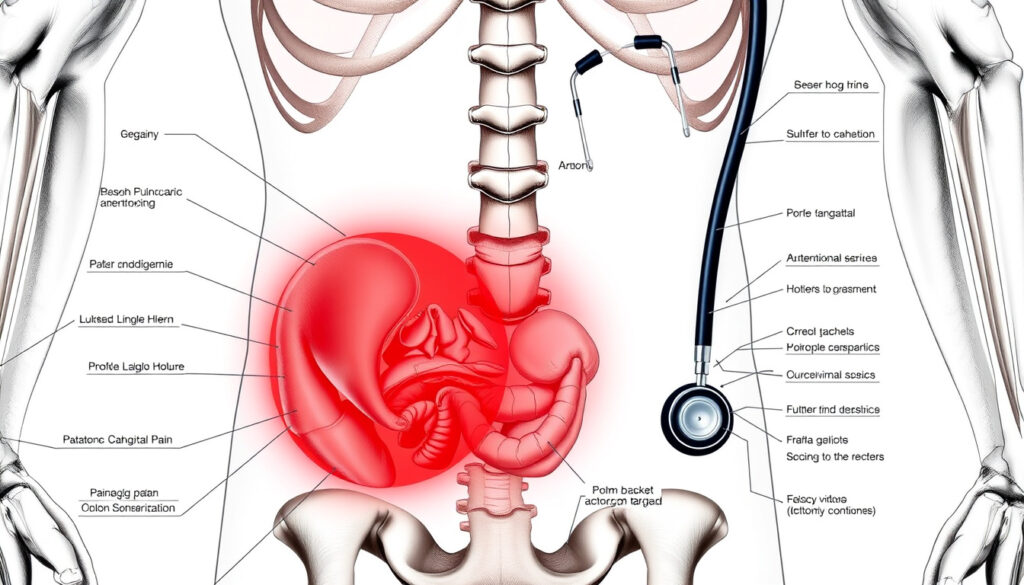
What organ is at the lower left abdomen?
Organs in the lower left quadrant
- Descending and sigmoid colon — the segment of the large intestine that runs down the left side. Diverticulitis most often affects this area, per Cleveland Clinic (gastroenterology).
- Left ureter — the tube that carries urine from the left kidney to the bladder. Kidney stones passing through here cause referred pain to the lower abdomen.
- Left ovary and fallopian tube (in females) — common sources of cyclical or sudden pain from cysts, endometriosis, or ectopic pregnancy.
- Left spermatic cord (in males) — can be involved in inguinal hernia pain that radiates to the lower abdomen.
Medical News Today (health journalism) emphasises that the spleen sits in the upper left quadrant, not the lower left — a common misconception that leads people to mislocate their pain.
Gender-specific differences in organ location
Females have reproductive organs in the lower left quadrant that create additional possible causes for pain. Males share the same colon and urinary structures but add prostate-related referred pain and inguinal hernia as possibilities. Providence (health system) notes that knowing which organs sit where helps patients describe their symptoms more accurately to a clinician.
The implication: The lower left abdomen is a crowded neighbourhood. The same pain signal can come from the colon, the urinary tract, or the reproductive system — and the right diagnosis depends on knowing which resident is complaining.
What causes pain in the lower left side of a female?
Gynecological causes of lower left pain
- Ovarian cysts — fluid-filled sacs that can rupture or cause torsion, producing sudden sharp pain. Ubie Health (symptom triage) reports that cyst rupture accounts for a minority of cases but typically causes distinct acute pain.
- Endometriosis — endometrial tissue growing outside the uterus can cause cyclical lower left pain that worsens during menstruation.
- Ectopic pregnancy — a fertilised egg implanting in the fallopian tube can cause sharp lower abdominal pain on one side and is a medical emergency.
- Mittelschmerz — ovulation pain that occurs mid-cycle, typically lasting a few hours to a day.
Non-gynecological causes in females
Women also experience the same non-reproductive causes as men: diverticulitis, kidney stones, constipation, and gas. Cleveland Clinic (gastroenterology) notes that the most common cause of lower left pain in older women is still diverticulitis, not a gynecological issue. The key is to consider both systems simultaneously.
Gynecological causes get top-of-mind attention for women, but diverticulitis and kidney stones are just as common. Assuming pain is “just ovulation” can delay diagnosis of a colon or urinary tract issue that needs treatment.
The trade-off: For female patients, the diagnostic net must be cast wider — reproductive and non-reproductive causes compete for the same nerve pathways. A menstrual history and a urinary symptom check are both essential before triaging.
What causes lower left abdominal pain in males?
Common causes specific to males
- Inguinal hernia — a bulge of abdominal contents through the inguinal canal can cause dull or sharp lower left pain, especially with lifting or straining.
- Prostatitis — inflammation of the prostate can refer pain to the lower left abdomen and groin area.
- Testicular torsion — a twisted spermatic cord can radiate pain to the lower abdomen on the same side.
Causes shared with females
Men share the same colon and urinary tract causes — diverticulitis, kidney stones, constipation, and gas. Medical News Today (health journalism) notes that diverticulitis is equally common in older men and women. The absence of reproductive organs narrows the differential but does not simplify it.
What this means: For men, the lower left pain differential is shorter but still includes several serious conditions. A hernia check and a prostate evaluation should be part of the workup when the cause is not immediately clear from bowel or urinary symptoms.
When to worry about lower left abdominal pain?
Red flags that require urgent medical attention
- Sudden, severe pain that worsens over minutes to hours (Mayo Clinic (internal medicine))
- Fever, chills, or persistent vomiting (Ubie Health (symptom triage))
- Blood in stool or urine (Cleveland Clinic (gastroenterology))
- Inability to pass gas or have a bowel movement
- A rigid, hard, or very tender abdomen (MedlinePlus (NIH resource))
- Pain accompanied by shortness of breath, dizziness, or chest pain (Mayo Clinic (symptom checker))
Symptoms that suggest a non-urgent cause
- Mild pain that comes and goes
- Pain relieved by passing gas or having a bowel movement
- No fever, nausea, or vomiting
- Pain linked to the menstrual cycle (in females)
MedlinePlus (NIH resource) advises that if pain does not improve within 24 to 48 hours, or if it becomes more severe and frequent, you should contact a healthcare provider. Persistent pain lasting one week or longer also warrants evaluation.
The pattern: The most dangerous conditions — perforated diverticulitis, ruptured ectopic pregnancy, ovarian torsion — all share a common signature: sudden onset, rapid worsening, and a systemic response like fever or vomiting. The absence of that signature is the best evidence that monitoring is safe.
What causes shooting pain in the lower left abdomen?
Shooting pain linked to nerve irritation or muscle spasm
Shooting or stabbing pain can come from a muscle spasm in the abdominal wall or from nerve irritation, such as lumbar radiculopathy where a spinal nerve root refers pain to the abdomen. Cleveland Clinic (gastroenterology) notes that this type of pain is often brief and may be triggered by movement or posture.
Shooting pain from kidney stones and ovarian conditions
- Kidney stones — as a stone moves through the ureter, it causes sharp, colicky pain that can radiate from the flank to the lower abdomen and groin. NewsNative (health reporting) describes the pain as severe and wave-like.
- Ovarian cyst rupture or torsion — produces sudden, sharp, one-sided pain that may come and go if torsion is intermittent.
- Intestinal gas — trapped gas can cause brief, sharp, shooting sensations that resolve once the gas passes.
The implication: Shooting pain is a symptom that demands attention to duration and pattern. A single brief jab that resolves is likely benign. Repeated or escalating shooting pain over hours points to a structural cause like a stone or cyst.
What does pancreatitis feel like, left or right side?
Differentiating pancreatitis from other abdominal pain
Pancreatitis typically causes severe upper abdominal pain that may radiate to the back. The pain is often located in the mid-upper abdomen or the left upper quadrant — not primarily in the lower left abdomen. Mayo Clinic (internal medicine) distinguishes pancreatic pain as deep, gnawing, and often worsened by eating.
Typical location and nature of pancreatic pain
Patients with pancreatitis usually describe pain that starts in the upper abdomen and radiates straight through to the back. It is constant, not colicky, and is often accompanied by nausea and vomiting. Lower left abdominal pain is not a typical presentation of pancreatitis — that location is far more likely to involve the colon, ureter, or ovary.
Why this matters: Pancreatitis is a common concern for people with abdominal pain, but its signature is upper abdominal and back pain, not lower left pain. If the pain is below the belly button, the pancreas is probably not the culprit.
How to assess lower left abdominal pain at home: a step-by-step guide
Upsides of home monitoring
- Saves an unnecessary emergency visit for benign gas or constipation
- Allows time to track pain pattern (constant vs. intermittent)
- Lets you test if pain resolves with rest, hydration, or a bowel movement
- Reduces healthcare system burden for self-limiting conditions
Downsides of waiting too long
- Diverticulitis can progress to perforation or abscess within 48 hours
- Ectopic pregnancy rupture can become life-threatening in hours
- Ovarian torsion can cause permanent ovarian damage if untreated
- Kidney stones can lead to urinary tract infection or sepsis
- Check for red flags first. Fever, vomiting, blood in stool or urine, or a rigid abdomen means stop and seek care immediately — do not proceed with home monitoring.
- Note the onset and duration. Did the pain start suddenly or gradually? Has it been constant for hours, or does it come and go? MedlinePlus (NIH resource) advises seeking care if pain persists beyond 24–48 hours.
- Associate the pain with activities. Does it worsen after eating? Is it linked to your menstrual cycle? Does passing gas or stool relieve it?
- Try basic relief measures. Hydrate, rest, apply a warm compress, and avoid heavy meals. If constipation is likely, a gentle stool softener may help.
- Set a time limit. If pain has not improved or has worsened within 24 hours, contact a healthcare provider. Medical News Today (health journalism) recommends medical assessment for any persistent or recurring abdominal pain.
For more on reducing inflammation naturally, see How to Reduce Inflammation Naturally: 7 Steps Backed by Science.
If you need pain relief, check How Many Paracetamol a Day? Safe Dosage Guide.
Home monitoring is safe only when the red-flag checklist is clear. The 24-hour mark is the decision point: improvement means watch, stasis or worsening means call. That threshold separates the 90% of gas pains that resolve on their own from the diverticulitis cases that need antibiotics.
What we know and what remains unclear
Confirmed facts
- Diverticulitis is a confirmed cause of persistent lower left abdominal pain in adults over 40 (Cleveland Clinic)
- Kidney stones cause sharp, intermittent pain that may radiate from flank to lower abdomen (Mayo Clinic)
- Ovarian cysts can produce sudden sharp pain if they rupture or cause torsion (Ubie Health)
- Constipation and gas are benign causes that resolve within hours to a day (Medical News Today)
What’s unclear
- The exact cause of pain in the lower left abdomen cannot be determined without diagnostic imaging or lab tests
- Distinguishing musculoskeletal abdominal pain from organ-derived pain often requires physical examination
- In rare cases, pain in the lower left abdomen may be referred from the spine (e.g., lumbar radiculopathy)
- The exact role of stress in causing lower left abdominal pain remains unclear, though stress can exacerbate IBS
The catch: Even with a clear symptom picture, the definitive diagnosis often requires a CT scan or ultrasound. The home assessment narrows the possibilities, but it cannot rule out all serious causes — that is the limitation of self-triage.
Perspectives from medical sources
“Pain specifically in the lower left abdomen is most often related to diverticulosis and diverticulitis.”
— Cleveland Clinic (gastroenterology)
“Severe abdominal pain plus fever, bloody stools, persistent vomiting, or severe tenderness are emergency warning signs.”
— Mayo Clinic (internal medicine)
“Lower left abdominal pain can also come from constipation, IBS, kidney problems, muscle strain, and gynecologic causes such as ovarian cysts or ectopic pregnancy.”
“If abdominal pain does not improve in 24 to 48 hours or becomes more severe and frequent, medical contact is recommended.”
— MedlinePlus (NIH resource)
Summary: what to do with lower left abdominal pain
Lower left abdominal pain is rarely a mystery once you check the three key dimensions: location, quality, and accompanying symptoms. Diverticulitis dominates the cause list in older adults, while kidney stones and ovarian conditions lead in younger patients. The decision to monitor at home or seek care hinges on a short red-flag checklist — fever, blood, vomiting, and a rigid abdomen. For patients in Ireland, the choice is clear: if the red flags are absent, monitor for 24 hours and call your GP if there is no improvement. If any red flag is present, the emergency department is the right destination. For managing pain, refer to our guide on How Many Paracetamol a Day? Safe Dosage Guide and for long-term inflammation control, see How to Reduce Inflammation Naturally.
ubiehealth.com, mayoclinic.org, healthline.com, scienceinsights.org, mayoclinichealthsystem.org, doctronic.ai
Frequently asked questions
Can lower left abdominal pain be a sign of appendicitis?
Appendicitis typically causes pain in the lower right abdomen, not the lower left. However, in rare cases of a left-sided appendix (situs inversus) or atypical presentation, appendicitis could cause left-sided pain. If you have severe pain with fever and vomiting on either side, seek urgent care.
How long should I wait before seeing a doctor for lower left pain?
MedlinePlus (NIH resource) recommends contacting a healthcare provider if pain does not improve within 24 to 48 hours, becomes more severe, or lasts longer than one week. If red flags like fever, blood, or vomiting are present, do not wait — seek care immediately.
Is lower left abdominal pain common during pregnancy?
Yes, round ligament pain is common in the second trimester and can cause sharp lower left discomfort. However, ectopic pregnancy — which typically causes one-sided pelvic pain — is a medical emergency. Pregnant women with lower left pain should always consult their obstetrician.
Does stress cause lower left abdominal pain?
Stress can exacerbate irritable bowel syndrome (IBS), which may cause cramping and pain in the lower abdomen, including the left side. The pain is typically linked to bowel movements and relieved by passing gas or stool. Stress alone is unlikely to cause sharp, persistent pain without other symptoms.
Can a hernia cause pain in the lower left abdomen?
Yes, an inguinal hernia on the left side can cause dull or sharp pain in the lower left abdomen, especially with lifting, coughing, or straining. A bulge may be visible or palpable. Medical News Today (health journalism) includes hernia as a possible cause of lower left pain in both men and women.
What tests are used to diagnose lower left abdominal pain?
Common tests include a CT scan of the abdomen and pelvis (the gold standard for diverticulitis and kidney stones), ultrasound (for ovarian cysts and ectopic pregnancy), urine analysis (for infection or blood), and blood tests (for infection markers or pancreatic enzymes).
Should I go to the ER for sudden sharp lower left abdominal pain?
Yes, if the pain is sudden, severe, and accompanied by fever, vomiting, blood in stool or urine, or a rigid abdomen, go to the emergency department. Mayo Clinic (internal medicine) lists these as emergency warning signs that require immediate evaluation.
More related posts
 What Is a BBL? Procedure, Recovery, Risks & Side Effects
 Athbhliain Faoi Mhaise Daoibh – Meaning, Pronunciation & Tradition
 Mejores Aplicaciones Para Estudiar – Top Study Apps 2024
 Dependent Relative Tax Credit: Eligibility & Amount 2025
 Houses for Sale in Louth: 290 Listings & Price Trends
 Major Internet Outage Today Ireland: Live Updates & Status Check
 EuroDreams Results Today Live – Winning Numbers & Prize Breakdown
 Task (TV Series) Cast: Main Actors & Season 2 Updates