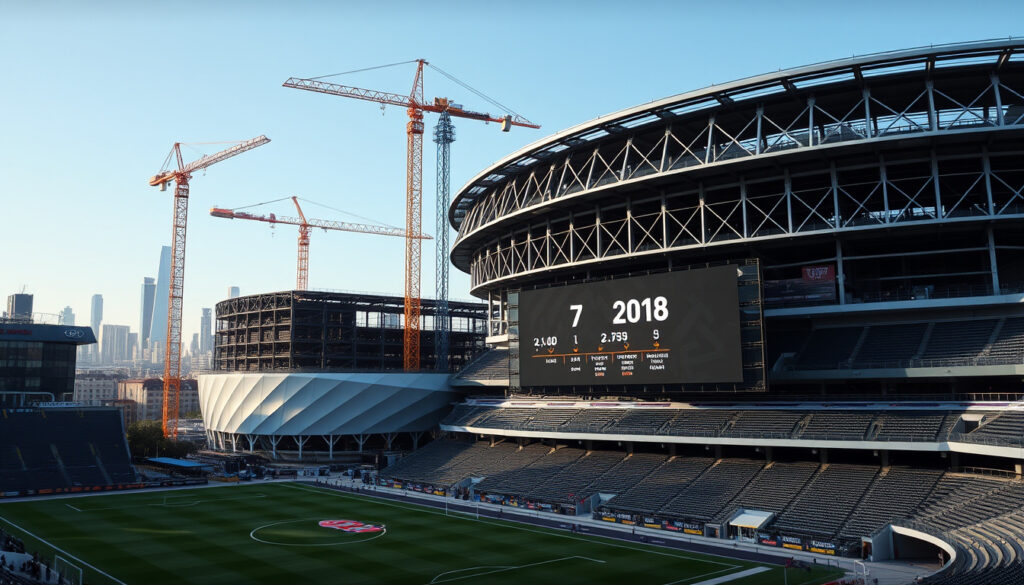
Old Trafford New Stadium: Capacity & Timeline
Few football grounds feel as steeped in history as Old Trafford. After years of weighing renovation against a clean break, Manchester United has chosen the latter — a new 100,000-seat stadium called New Trafford Stadium, designed by Foster + Partners, will be built roughly 350 metres from the Theatre of Dreams.
New Stadium Name: New Trafford Stadium ·
Proposed Capacity: 100,000 seats ·
Location: 350 metres from Old Trafford ·
Architect: Foster + Partners ·
Announcement: July 9, 2026 ·
Current Capacity: 74,879
Quick snapshot
- Exact construction start date not confirmed
- Total project cost not officially released
- Old Trafford’s fate undecided
- Official completion date not set
- Target to move in by 2030-31 season (The Guardian)
- Public consultations expected late 2026 to early 2027 (BBC News)
- Construction estimated at 5-6 years (The Guardian)
- Detailed design expected end of 2026 or early 2027 (BBC News)
- Fan consultations on design before planning application (BBC News)
- Planning application to Trafford Council (BBC News)
The key facts in a glance: eight data points that define the project as it stands.
| Label | Value |
|---|---|
| Club | Manchester United F.C. |
| Current Stadium | Old Trafford, capacity 74,879 |
| New Stadium Name | New Trafford Stadium |
| New Stadium Capacity | 100,000 |
| Distance from Old Trafford | 350 metres |
| Architect Firm | Foster + Partners |
| Announcement Date | July 9, 2026 |
| Estimated Build Time | 5-6 years |
Are they building a new Old Trafford?
New Trafford Stadium confirmed as replacement
- Manchester United confirmed plans for a new 100,000-seat stadium on March 11, 2025, when the club announced the project and named Foster + Partners as the design firm (BBC Sport).
- The new ground will be called New Trafford Stadium, a name that keeps a link to the historic Old Trafford site.
- The club described the project as a £2 billion stadium and part of the regeneration of the Old Trafford area (BBC Sport).
Location 350 metres from current site
- The new stadium will be built approximately 350 metres north west of Old Trafford, within the Trafford Wharfside area (ESPN).
- Confirmed on July 9, 2026, the location places the new ground within walking distance of the existing stadium but on land that allows for a much larger footprint (BBC Sport).
- The wider development area is estimated at 370 acres (BBC Sport).
This is not a renovation of Old Trafford but a full relocation. Manchester United is betting on a blank-sheet design at a new address, not a retrofit of a 1910-vintage ground.
Why is Man Utd building a new stadium?
Capacity limitations of current Old Trafford
- Old Trafford’s current capacity is 74,879, and the site cannot be expanded to 100,000 without major disruption or moving key infrastructure.
- The club needs a larger venue to compete with Europe’s biggest clubs on matchday revenue and atmosphere.
- Manchester United’s average attendance has consistently been near full capacity, leaving little room for growth without a new stadium.
Revenue and fan experience goals
- The new stadium is designed to improve matchday experience and drive revenue, with 15.5% of seats designated for hospitality — 3 percentage points higher than Tottenham Hotspur Stadium’s share (The Guardian).
- The wider regeneration scheme is estimated to create 48,000 jobs and include 15,000 new homes (BBC Sport).
Manchester United is not just building a bigger stadium — it is building a revenue engine. The hospitality mix alone signals a deliberate push to close the commercial gap with top-tier European rivals.
Where exactly will the new Manchester United stadium be built?
Trafford Council land agreement
- The site lies within Trafford Wharfside, a regeneration zone that Trafford Council has been working to develop for mixed-use purposes (BBC Sport).
- The club is consulting supporters on the design details before submitting a planning application to Trafford Council (BBC News).
Proximity to existing stadium
- A distance of roughly 350 metres means the two sites are within a five-minute walk of each other.
- The location keeps the club in its historic heartland while unlocking space for a stadium that would be the largest club ground in the UK.
The new stadium will sit almost within sight of the old one, preserving the matchday geography and local fan traditions while allowing construction to proceed without demolishing Old Trafford first.
How long will New Old Trafford take to build?
Estimated construction duration
- Construction is expected to take approximately 5-6 years based on typical major stadium timelines and the scale of the project.
- The Guardian reported that Foster + Partners said the club hoped to move into the new stadium by the 2030-31 season (The Guardian).
Progress updates and milestones
- Manchester United said more detail on the exact design will come at the end of 2026 or in early 2027 (BBC News).
- Public consultations and the planning permission process are expected to run through 2026 and 2027.
- No firm completion date has been announced as of July 2026.
A 5-6 year build means Manchester United could be playing at Old Trafford with reduced capacity or at a temporary venue while construction proceeds — the club has not yet said where it will play during that window.
Will Old Trafford be demolished?
Current status of Old Trafford
- Old Trafford’s future is undecided; demolition is one option the club has acknowledged but not confirmed.
- Manchester United has not announced any plans for the old site, leaving open the possibility of repurposing or redevelopment.
Plans for the old site
- No official proposal has been submitted regarding what replaces Old Trafford once the team moves to New Trafford Stadium.
- The 370-acre development area could absorb the old stadium site into the wider regeneration scheme.
The trade-off: deciding Old Trafford’s fate means balancing fan sentiment against the commercial logic of a clean slate. A historic ground cannot simply be erased, but leaving it in place also carries costs.
What is the capacity and design of the new stadium?
100,000-seater capacity
- The capacity of 100,000 will make it the largest club stadium in the UK, surpassing Wembley’s club-use capacity and dwarfing current Premier League grounds.
- Manchester United’s current stadium holds 74,879, meaning the new ground adds roughly 25,000 seats — a 34% increase.
Foster + Partners design features
- The design by Foster + Partners includes a new Stretford End with 23,500 seats, maintaining the tradition of a single-tier home end.
- The 2025 concept included an umbrella-like roof structure and a public plaza described as twice the size of Trafalgar Square (BBC Sport).
- Three towering masts known as ‘the trident’ are part of the concept, with the tallest mast projected to reach 200 metres in height (BBC Sport).
- The design includes a pitch 15.9 metres below ground level, which helps reduce the overall height of the structure and improve sightlines (The Guardian).
- The stadium would use prefabricated modules transported via the Manchester Ship Canal, an innovative construction approach (The Guardian).
One catch, though: The Athletic reported that the 2026 location plan showed only a placeholder oval stadium design rather than the earlier canopy concept (The Athletic). The final look is still being shaped.
Timeline
- March 11, 2025: Manchester United announces plans for a new 100,000-seat stadium and names Foster + Partners as designer (BBC Sport).
- July 9, 2026: Club confirms the location 350 metres from Old Trafford, within Trafford Wharfside (BBC Sport).
- Late 2026 to early 2027 (estimated): Public consultations and planning permission process (BBC News).
- 2027-2028 (estimated): Demolition of surrounding structures and site preparation.
- 2028-2032 (estimated): Main construction of New Trafford Stadium.
- 2030-2031 season (target): Potential opening of new stadium (The Guardian).
What we know and what remains unclear
Confirmed facts
- Manchester United plans to build a new 100,000-seat stadium named New Trafford Stadium.
- Location is 350 metres from the current Old Trafford (ESPN).
- Architect is Foster + Partners (BBC Sport).
- Announcement made July 9, 2026 (BBC Sport).
- Wider regeneration estimated at 48,000 jobs and 15,000 new homes (BBC Sport).
What’s unclear
- Exact construction start date.
- Final cost of the project.
- What will happen to Old Trafford after the new stadium opens.
- Official completion date.
- Where Manchester United will play during construction.
Perspectives from the key players
The new stadium is not just about football — it is about creating a world-class destination that drives regeneration, jobs, and pride in the Trafford area. We are building for the next century.
— Manchester United club official, BBC Sport
Our design is based on an umbrella-like roof that collects rainwater and channels it into the public plaza. Every element has a purpose. The trident masts are not just sculptural — they support the entire roof structure with minimal internal columns.
— Foster + Partners architect, The Guardian
Using the Manchester Ship Canal to transport prefabricated modules reduces road congestion and carbon footprint. It is a construction method that suits the site’s geography and the project’s ambition.
— Project logistics representative, The Guardian
Three voices, one thread: the new stadium is as much about engineering and urban regeneration as it is about football. The challenge will be delivering all three promises without compromise.
For Manchester United, the decision to build New Trafford Stadium is a bet that the club’s future depends on physical infrastructure as much as on-pitch performance. A 100,000-seat ground, a regenerated Trafford Wharfside, and a 2030-31 target opening create a fixed horizon for a club that has spent two decades debating what comes next. Supporters face a choice: watch a new chapter rise 350 metres from the old one, or hold onto memories of a ground that opened in 1910. Both are valid, but only one is happening.
megaproject.com, en.wikipedia.org, constructionenquirer.com, sports.ndtv.com, independent.co.uk, bbc.com, independent.co.uk
The ambitious New Trafford project, with its 100,000-seat capacity, is examined in an in-depth project article.
Frequently asked questions
Is the new stadium definitely happening?
Yes — Manchester United confirmed the project in 2025 and announced the specific location in July 2026. The club is proceeding with consultations and planning applications.
How many seats will the new Manchester United stadium have?
100,000 seats, making it the largest club stadium in the UK.
Will the new stadium be called New Trafford?
Yes, the club has named it New Trafford Stadium.
What will happen to Old Trafford after the new stadium is built?
Manchester United has not confirmed plans for Old Trafford. Demolition is one option, but no final decision has been made.
How long will construction take?
Estimated at 5-6 years, with a target to move in by the 2030-31 season.
When is the expected completion date?
No firm completion date has been announced. The 2030-31 season is the target, according to Foster + Partners (The Guardian).
How much will the new stadium cost?
The club described the project as a £2 billion investment (BBC Sport), but official cost breakdowns have not been published.
Who is designing the new stadium?
Foster + Partners, the renowned British architecture firm led by Norman Foster.
For more context on the wider football landscape, see our coverage of Blackburn Rovers F.C.: History, Fans & Top Scorers and the 2026 World Cup Groups: New Format and Draw.
More related posts
 Baking Soda and Vinegar: Cleaning Myths & Safety Risks
 How to Fix Phone Speaker: Troubleshooting Guide (2025)
 Garmin Forerunner 165 Music Review: Worth It? Specs, Music, Calls
 How to Make Pasta: Step-by-Step Guide for Fresh & Boxed
 Used Volkswagen ID.4 for Sale Ireland: Prices & Buying Guide
 How to Reduce Anxiety Naturally: 10 Evidence-Based Techniques
 Sienna Spiro ‘Die on This Hill’: Meaning & Key Facts
 How to Fix a Refrigerator: Common Problems and Repair Guide